Arthur Hayden was a long serving signalman on the Great Eastern Railway. Born into a railway family Arthur’s family had moved to Weeting by the time he was eleven years old, and he seems to have joined the railway as soon as he could. In 1885 he married Sybille Smythe, a Brandon girl. On the 19th January 1887 Sybille gave birth to a son, Harry.
At first, Harry followed the family tradition and joined the railway but it seems that this wasn’t to his liking and on 24th April 1907 he took the King’s Shilling and joined the army. After completing his paperwork in Great Yarmouth, Harry was posted to “C” Company of the 1st Battalion Rifle Brigade in Winchester. A year in Ireland followed, then the Battalion embarked for India, His service in India seems to have been fairly unremarkable. Other than a few brief stay in a military hospital for “fits” his record is almost unblemished. The low point would have been when he was confined to barracks for eight days in 1910 for “Irregular conduct in town, when on duty in aid of Civil Powers”. By way of contrast, the next year he attended the great Delhi Durbar as a special messenger.
Army life must have suited Harry, as in 1914 he signed on for a further two years to be served in India “provided a unit of my Corps is serving in the country”. Of course this wasn’t to be and in September 1914 the battalion left Kuldana and moved to Bomaby, from where they embarked on a ship to Liverpool. After arriving in Liverpool on October 22nd, they transferred to Hursley Park, near Winchester, where the battalion became part of the 8th Division. The division was posted to France in early November, where the 2nd battalion arrived via Le Havre on November 6th.
Following a winter in the trenches, the battalion took part in the battle of Neuve Chapelle – a successful attempt to breach the German front line. Although a deemed a success by the British generals, the battle proved to be poor Harry’s undoing. He was wounded, and despite the care he received in No 2 British Red Cross Hospital, Rouen, Harry succumbed to his injuries and died on 17th March 1915. He is interred in St Sever Cemetery, along with 3095 fellow servicemen.

So why isn’t Harry on Weeting’s war memorial? The answer comes from the 1901 census. In this Arthur, Sybille and Harry are living at “Marsh Junction”, Haddiscoe along with Harry’s younger sisters, Nelly, Hilda and Dora. All three girls are recorded as having been born in Haddiscoe and it seems that the family made Haddiscoe their long term home. It is fitting then, that Harry’s name is one of the 23 engraved in the stone of Haddiscoe’s memorial to the fallen of World War One.
| Victory Medal | British War Medal |
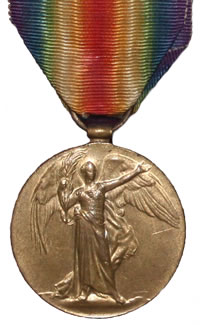 | 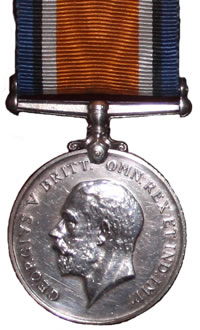 |
The information presented here has been derived from surviving public and military records as well as from contemporary press reports. We hope you find it of interest ‐ if you think we have made an error, or can add any further details, please get in touch.