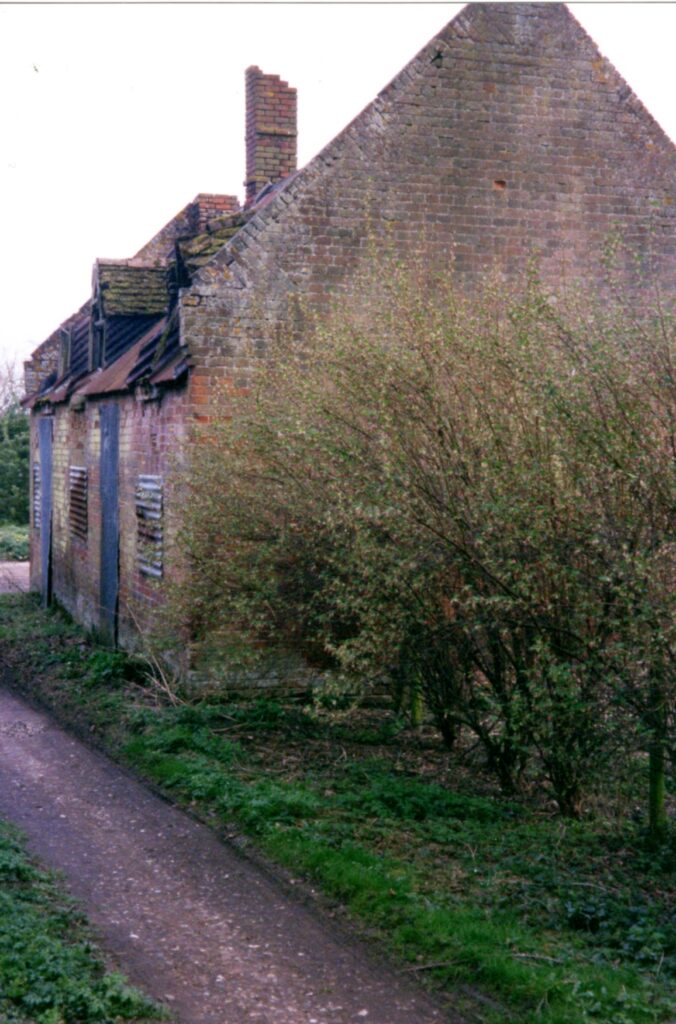
From ancient times until the end of the First World War, the horse provided the primary source of power on the farm and in transportation. The smithy therefore was a place of importance, not only for servicing the feet of the horses; it was the central meeting place for the men of the village, to catch-up on local news and gossip. Although the shoeing of horses provided the majority of work for the blacksmith, local farmers and workers from the Weeting Hall Estate would have brought machinery and implements to be serviced and repaired. He would also have made a range of hand tools and general ironmongery, like gate hinges, catches, brackets and the like.
Forge Cottage was constructed in two distinct lateral sections with bricks of different colours, suggesting that originally it was a single storey building. It had a central beam running the length of the ground floor and a central large chimney.
A lean-to washhouse was attached to the north side. It is possible that the original single storey building was the blacksmith’s workshop and that he lived elsewhere.
The shoeing shed (or Trav’us, the East Anglian dialect term) that stood at the end of a short driveway known as Ketts Lane adjacent to Forge Cottage was probably a later addition.
There is also evidence that Forge Cottage was divided into two dwellings. An 1885 map of the village shows two dwellings and gardens and in the 1917 sales document for the Weeting Hall Estate, the property is described as:
Pair of Brick and Tiled Cottages in Rectory Lane, Weeting. One containing 3 rooms. Living room, kitchen, larder and outside wash-house. Let to Mrs Steele at £3 year and the other with 3 rooms, scullery and Wash-house, let with Fengate farm.
The Forge, Weeting. Consisting of a brick tiled shoeing shed, let to Mr O. Carter at £3 a year, tenant paying rates.
Leslie (Bunny) Hunt was born in The Row in 1919 and in his memoir recalling life in the village during the 193O’s, remembers that Forge Cottage was divided into two dwellings. A Mr Pollard, a retired gamekeeper lived in one part and a Mr Steele in the other. This is was not the Edward Lee Steele listed in the 1904 Kellys Directory, as Edward died in 1914.
Occupants of the forge are listed in documents at the Norfolk Record Office, Whites and Kellys Directories and they show that the Steele family were the blacksmiths for Weeting for fifty-three years. There are blacksmiths listed in the village as early as the late 1600’s but no location is given.
- 1679 ]ohn Cocke, blacksmith, owned land and cottage in the village (NRO)
- 1851 Frederick Steele, blacksmith, Rectory Lane, aged 26 (Census)
- George Steele, blacksmith, Rectory Lane, aged 24 (Census)
- 1864 Frederick Steele, blacksmith, Rectory Lane (NRO)
- 1881 George Steele, blacksmith, Rectory Lane, aged 49,disabled (Census)
- Edward Steele, blacksmith, Rectory Lane, aged 23, son of Ellen (Census)
- 1896 Ellen Steele Mrs, blacksmith, Rectory Lane (Whites)
- 1901 Robert Haylet, blacksmith, Rectory Lane (lodger), aged 25 (Census)
- Edward Steele, blacksmith, Rectory Lane, aged 47 (Census)
- Ellen Steele, mother, Rectory Lane, aged 80 (Census)
- 1904 Edward Steele, blacksmith, Rectory Lane (Kellys)
- 1911 Edward Steele, blacksmith, Rectory Lane aged 54 (Census)
- Edward Arthur Ives, blacksmith, Fengate aged 29 (Census)
- 1917 Steele Mrs, renting Forge Cottage (Hall Estate sates documents)
- O Carter, blacksmith, renting shoeing shed (Hall Estate sales documents)
- 1921 Frank Kent 9 The Row, blacksmith’s assistant for Calders Timber Merchants, Brandon aged 17 (Census)
In 2002 Forge Cottage was examined by the Breckland Conservation Officer who stated, that in his opinion ‘The primary building is no earlier than mid-eighteenth century and not of listable quality.’ It was therefore doomed.